Prepare the session.
Review the patient. Surface relevant history, prior themes, completed assignments, and outstanding concerns. Draft a session plan grounded in the client's record.
Real-time, in-session support. Structured between-session work. Reviewed by your clinical team.
Built at the Global Center for AI in Mental Health, in partnership with SUNY Downstate and the University at Albany.
Developed in collaboration with Google's Rapid Innovation Team.
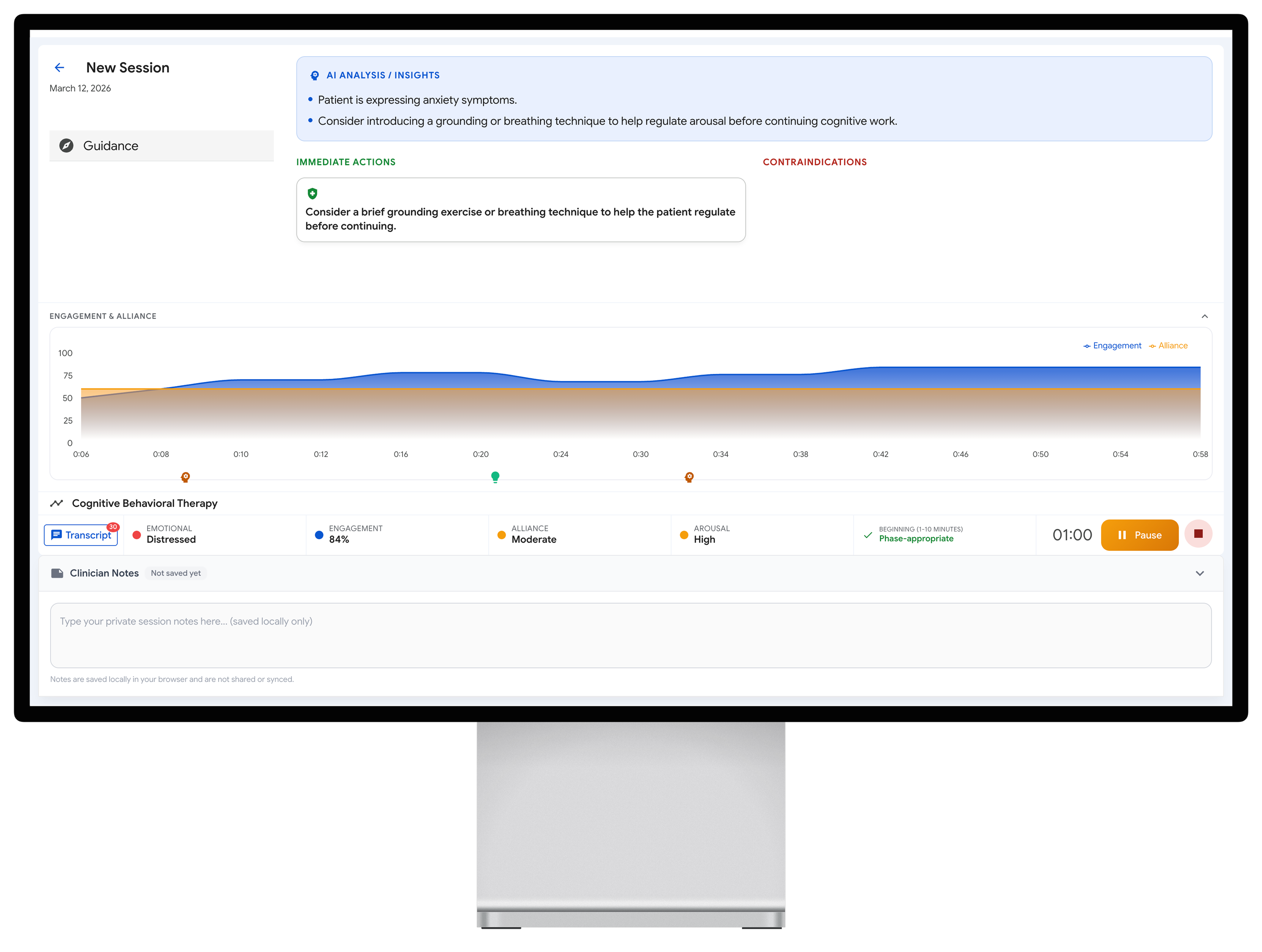
Transcribe
Live session transcription with speaker diarization.
Analyze
Engagement, alliance, and emotional state, surfaced in real time.
Guide
Evidence-based suggestions, displayed during the session.
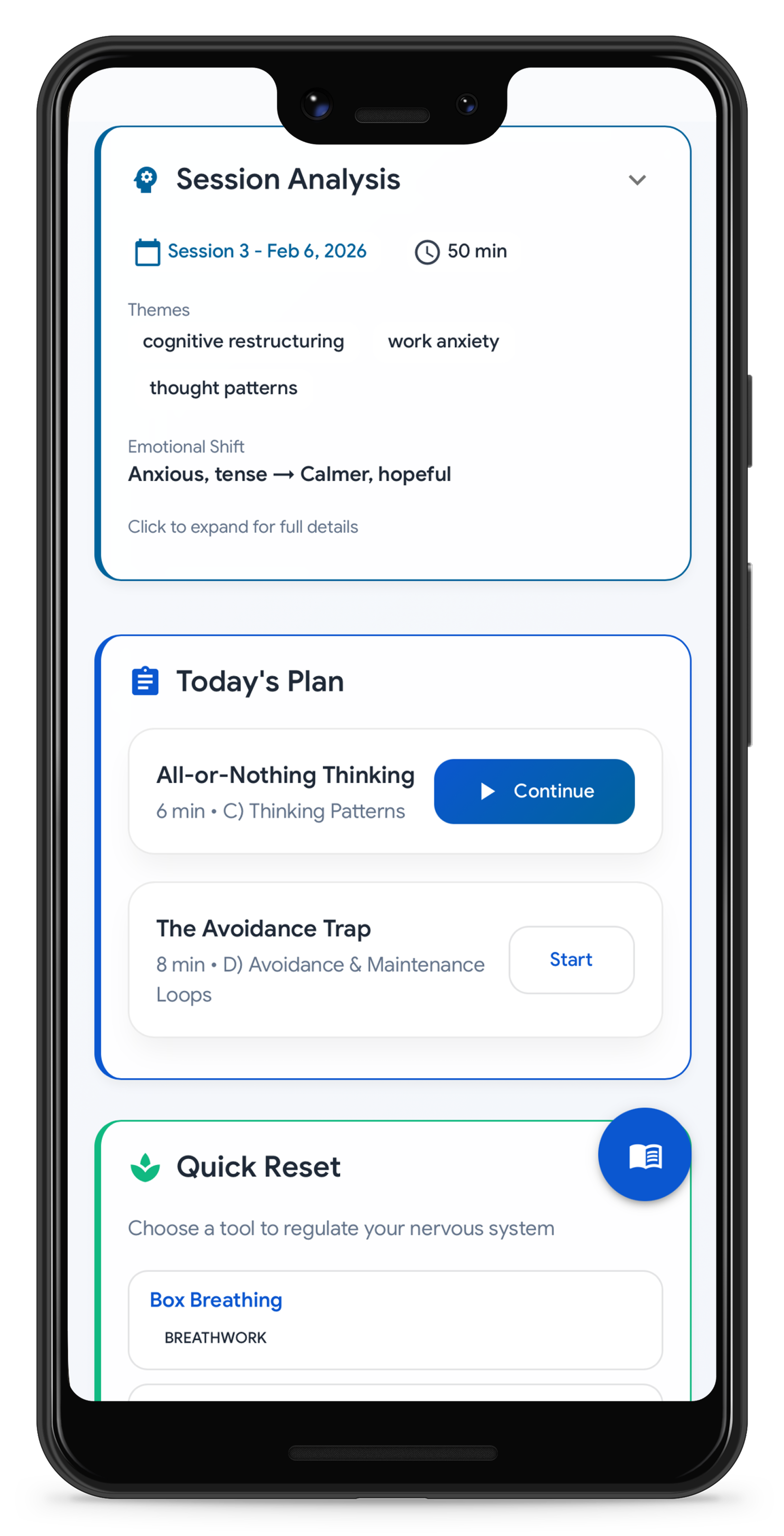
Continue
Personalized between-session work for the client.

The session, and the layer that supports it.
From preparation through live support, documentation, and between-session work.
From the Global Center for AI in Mental Health and its clinical partners.
Director, GCAIMH
Counseling Psychologist
University at Albany
Director, GCAIMH
Assistant Professor of Computational Neuroscience and AI
Downstate Health Sciences University
President, American Psychiatric Association
Chair and Professor, Department of Psychiatry
Downstate Health Sciences University
Director of Clinical Training
Associate Professor, Department of Psychology
University at Albany
Clinical Assistant Dean · Assistant Professor of Psychiatry
Director, Center of Excellence for Alzheimer's Disease
Downstate Health Sciences University
Director, AI Plus Institute
Empire Innovation Professor of AI
University at Albany
Four states. One continuous clinical layer.
Review the patient. Surface relevant history, prior themes, completed assignments, and outstanding concerns. Draft a session plan grounded in the client's record.
Real-time clinical support. Engagement, alliance, and emotional state signals; evidence-based suggestions; structured note scaffolding, displayed quietly and never disruptive.
Clinical documentation drafted from the session. Updated patient record, flagged concerns for review, and prepared between-session assignments.
A guided, educative space for the client between visits. Journaling, symptom tracking, assigned psychoeducation, and self-regulation tools, visible to the therapist before the next session.
A clinical co-pilot that respects the work.
Ther-Assist augments the clinician's judgment; it does not replace it. The system supports preparation, documentation, and continuity, and surfaces structured clinical signals during and between sessions, for the therapist's review and decision. Every recommendation, summary, and note draft is reviewable and editable before it enters a clinical record.
Recommendations are anchored in validated EBT documentation and therapy session corpora, reviewed by the GCAIMH clinical team.
Live transcription, engagement and alliance signals, emotional state and arousal indicators, and evidence-based suggestions, displayed without interrupting the room.
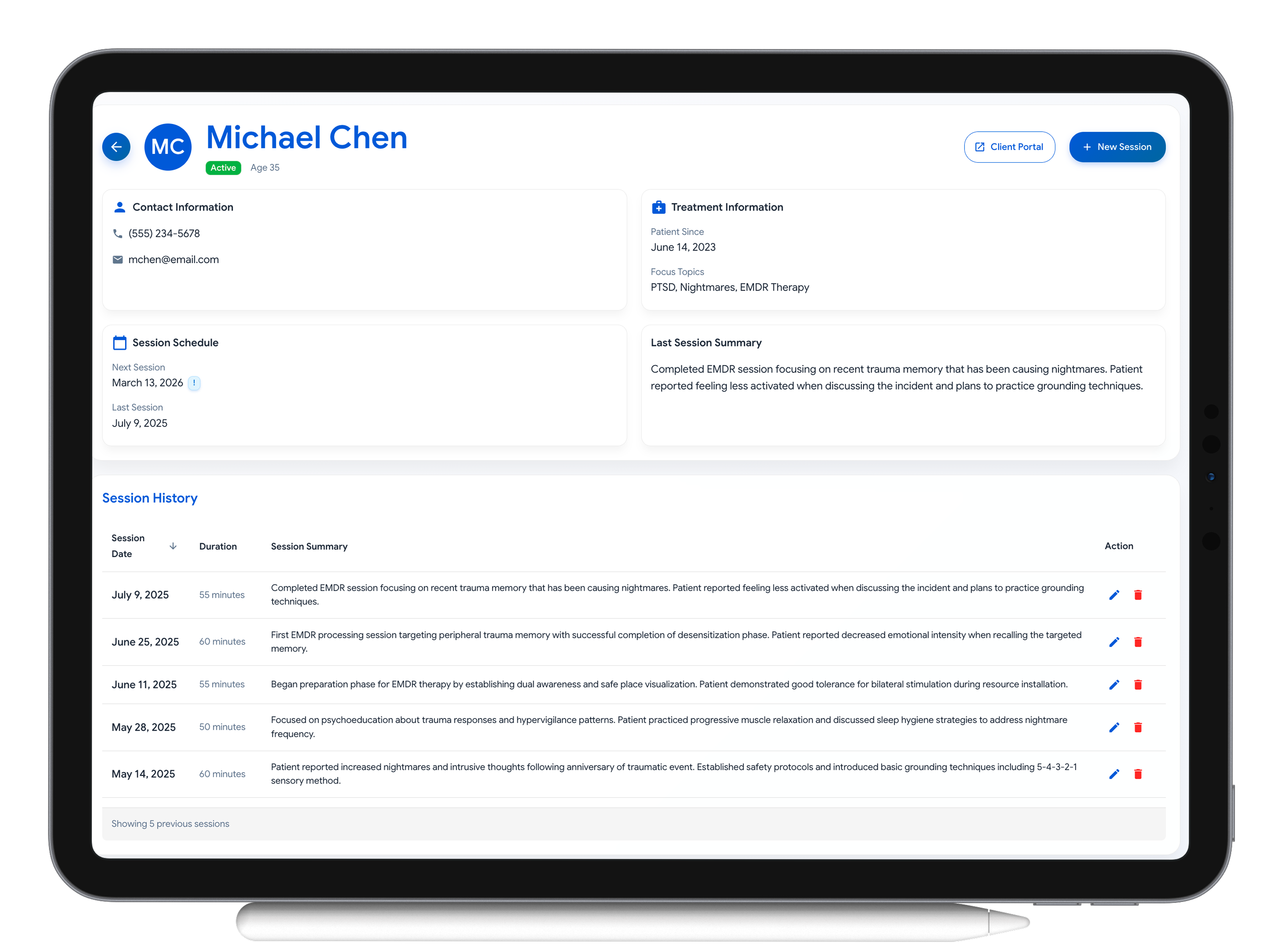
Structured notes drafted from the session transcript, ready for clinician review and editing.
Symptom trajectories, completed assignments, journal themes, and alliance signals over time. Surfaced before the next session, not buried in a chart.
Surfaced quietly for the clinician's interpretation, never as a directive. Example state from a representative session.
From the most recent analysis cycle.
Structured between-session support, assigned and supervised by the clinician.
The client-facing component is designed as a structured, educative extension of the clinician's care, not as a stand-alone conversational agent. It delivers psychoeducation, therapist-assigned exercises, journaling prompts, validated symptom measures, and progress visualization. Its scope is bounded by what the therapist has assigned; it does not provide independent therapeutic content or simulate a therapeutic relationship.
Evidence-based content drawn from a library curated by clinical scientists, grounded in psychology and informed by neuroscience, to help you understand your own goals and the work you're doing in therapy.
Coping strategies, self-regulation exercises, exposure work, and journaling prompts, assigned by your clinician and tracked in one place.
Brief, validated check-ins that give both you and your therapist a clearer signal over time.
Prompts that scaffold reflection, with the option to share entries with your therapist.
Measurement-based care, reduced administrative burden, standardized delivery of evidence-based treatment.
Ther-Assist supports clinical leaders working to deliver consistent, evidence-based psychotherapy across their teams. By reducing the documentation and preparation burden on individual clinicians and tracking outcomes systematically over time, the system helps health systems improve treatment fidelity, monitor patient progress, and expand the reach of evidence-based care.
Evidence-based protocols applied consistently across clinicians, grounded in content developed by the GCAIMH clinical team.
Validated outcome measures, symptom trajectories, and engagement signals, tracked systematically and surfaced for clinical and administrative review.
Reduced administrative load per session means more clients seen without compromising care. Between-session work expands therapeutic reach without expanding clinician hours.
HIPAA-aligned architecture and industry-standard encryption protect patient data throughout the system. Detailed safety and oversight commitments are described under Safety.
Architectural commitments that define what Ther-Assist does — and what it does not.
Ther-Assist is a clinical support tool that augments therapist judgment. It is not a stand-alone therapeutic agent, and the system is engineered so it cannot be used as one.
The system surfaces signals; the clinician decides. Every recommendation, note draft, and suggestion is reviewable and editable before it enters a record.
Enforced bya review-required gate on every generated artifact, and a versioned audit log.
The client portal is educative, not empathic. It will not perform connection, will not engage in unstructured emotional exchange, and will not present itself as a therapist.
Enforced bythe scope, scaffolding, and output policy of the client-facing system, and the structure of the content library.
Risk signals route the client to their clinician and to crisis resources. The system does not attempt to manage acute risk on its own.
Enforced byexplicit safety routing and escalation logic, with clinician notification pathways.
Content libraries, intervention recommendations, and outcome measures are curated and audited by the GCAIMH clinical team. Updates are versioned and visible.
Enforced bya clinician-reviewed content pipeline with version control.
Patient data is protected by design. The system is built on HIPAA-aligned architecture and follows industry-standard encryption practices. Every AI-generated clinical artifact — note draft, recommendation, summary — is reviewable by the clinician before it enters a record.
Enforced byHIPAA-aligned infrastructure, encryption practices, and clinician-reviewable artifact records.
Ther-Assist augments clinical judgment.
It does not replace it.
A partnership between SUNY Downstate, the University at Albany and the Health Innovation Exchange.
GCAIMH is a research center focused on the responsible development of AI for mental health care delivery. Ther-Assist is being developed as research infrastructure: clinically supervised, evaluated against measurable outcomes, and piloted at institutional partner sites before broader deployment.
An initial prototype of Ther-Assist was developed by domain experts from GCAIMH (including clinical psychologists, psychotherapists, and AI researchers) in collaboration with Google's Rapid Innovation Team. The clinical content layer, intervention library, and safety architecture are designed and reviewed by practicing clinicians.



For pilots, partnerships, research, or general inquiries. Reach out directly.
Director, GCAIMH
University at Albany
anitza@albany.eduDirector, GCAIMH
Downstate Health Sciences University
Salvador.Dura-Bernal@downstate.eduPrograms Coordinator
Downstate Health Sciences University
tarek.khashan@downstate.edu